In 1798–99, Matthew Flinders and George Bass sailed the colonial sloop Norfolk around the island that would become Tasmania, proving for the first time that it was indeed an island, separate from the Australian mainland — the discovery that gave Bass Strait its name. Dan Sprod tells the story of this landmark voyage of exploration, in which Flinders was accompanied by his famous ship's cat, Trim.
Walter B. Pridmore's brief history of the island known as Van Diemen's Land before it became Tasmania. Softcover, 2008, 67 pages, illustrated with colour paintings.
![Van Diemen's Land | James Boyce | 2021 Reprint [USED – HCDJ – Good]](https://onlinestore.bookcellar.com.au/images/T/van-diemens-land-boyce-hardcover-UeVSLg.png "Van Diemen's Land | James Boyce | 2021 Reprint [USED – HCDJ – Good]")
James Boyce's reinterpretation of Van Diemen's Land's early history — arguing that the convicts who arrived in the colony were transformed by the natural world they encountered, actively adapting to their new environment rather than simply enduring it. Almost half of all convicts transported to Australia came to Van Diemen's Land.
![Van Diemen's Land – An Aboriginal History | Murray Johnson & Ian McFarlane | 2015 [NEW – SC]](https://onlinestore.bookcellar.com.au/images/T/xctmpV44kt9.png "Van Diemen's Land – An Aboriginal History | Murray Johnson & Ian McFarlane | 2015 [NEW – SC]")
Murray Johnson and Ian McFarlane's detailed history of Aboriginal Tasmania — covering more than 35,000 years of Aboriginal presence on the island from before its separation from mainland Australia through European contact, colonisation, the Black War, and the forced exile of the surviving Aboriginal population to Flinders Island.

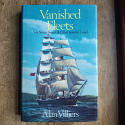
Alan Villiers went to sea at 15, and became one of the last captains of a commercial square-rigged sailing ship. Vanished Fleets gathers his stories of Van Diemen's Land's maritime history — pirates, whalemen, escaped convicts, adventurers and pioneers.
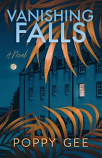
Deep within the lush Tasmanian rainforest is the remote town of Vanishing Falls, a place with a storied past.
![Vanishing Tasmania – A Photographic Essay | Frank Bolt | 1992 | Signed Limited Edition No. 319/1250 [USED – SC – Very Good]](https://onlinestore.bookcellar.com.au/images/T/vanishing-tasmania-frank-bolt-319-w7hFEq.png "Vanishing Tasmania – A Photographic Essay | Frank Bolt | 1992 | Signed Limited Edition No. 319/1250 [USED – SC – Very Good]")
Frank Bolt's photographic record of aspects of Tasmania that were disappearing at the time of publication — old buildings, rural structures, weathered farmhouses, abandoned machinery, forgotten corners of the landscape that were being lost to time, development and neglect.