![Convict Places – A Guide to Tasmanian Convict Heritage Sites | Michael Nash | 2020 [NEW – SC]](https://onlinestore.bookcellar.com.au/images/T/xctmp8Y7GrU.png "Convict Places – A Guide to Tasmanian Convict Heritage Sites | Michael Nash | 2020 [NEW – SC]")
More than 74,000 convicts were transported to Van Diemen's Land — and they left their mark across the entire island. Michael Nash's guide takes the reader to Tasmania's convict heritage sites, both well-known and lesser-known, examining how each operated during the transportation era and what visitors will find there today.
![Convict Tattoos – Examining and Illustrating the Tattoos of Convict Men and Women | Simon Barnard | 2016 [HCDJ]](https://onlinestore.bookcellar.com.au/images/T/convict-tattoos-yluug7.png "Convict Tattoos – Examining and Illustrating the Tattoos of Convict Men and Women | Simon Barnard | 2016 [HCDJ]")
At least 37% of male convicts and 15% of female convicts were tattooed by the time they arrived in the Australian penal colonies — making 19th century Australia one of the most heavily tattooed English-speaking societies in the world. Simon Barnard's book draws on the convict records held by Australian archives — particularly the physical description books that colonial authorities used to record individual convicts' distinguishing marks — to document and illustrate what those tattoos actually looked like.
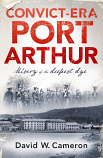
Convict-era Port Arthur - misery of the deepest dye - tells the fifty-year history of Port Arthur, one of the most remote and feared convict locations in colonial Australia, through the experiences of individuals who lived it. The author, David W. Cameron, draws on the words of convicts, soldiers and administrators to tell the story of Port Arthur's development, changing approaches to punishment, and eventual closure in 1877.
![Convicts & Carriageways – Tasmanian Road Development Until 1880 | Lyn Newitt | 1988 [USED – HC – Out of Print]](https://onlinestore.bookcellar.com.au/images/T/convicts-and-carriageways-IXeCfb.png "Convicts & Carriageways – Tasmanian Road Development Until 1880 | Lyn Newitt | 1988 [USED – HC – Out of Print]")
A history of road building in Tasmania up to 1880, written by Lyn Newitt and published in 1988. The book documents how Tasmania's road network was built using convict labour during the colonial period — the construction gangs, the road stations and probation parties, the engineering challenges of the terrain, and the development of the major routes that still largely define how Tasmanians travel the island today.
![Convicts Unbound – The Story of the Calcutta Convicts and Their Settlement in Australia | Marjorie Tipping | 1988 | Signed by Author [USED – HCDJ – Very Good]](https://onlinestore.bookcellar.com.au/images/T/convicts-unbound-1GXgxv.png "Convicts Unbound – The Story of the Calcutta Convicts and Their Settlement in Australia | Marjorie Tipping | 1988 | Signed by Author [USED – HCDJ – Very Good]")
Marjorie Tipping's history of the convicts transported to Australia on the ship Calcutta in 1803 — one of the earliest convict transports, carrying 299 convicts who were originally destined for Botany Bay but landed instead at Sullivan's Cove, becoming among the first European settlers in Van Diemen's Land.