- per page

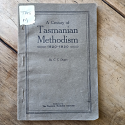
A scarce historical booklet detailing the pioneering families, ministers, and early church development of Methodism across Tasmania from 1820 to 1920. Packed with early regional records, this remains a valuable primary reference for local genealogy and social history researchers.
![A Compulsion to Kill – The History of Tasmania's Earliest Serial Killers | Robert Cox | 2014 [SC]](https://onlinestore.bookcellar.com.au/images/T/a-compulsion-to-kill-umkX6z.png "A Compulsion to Kill – The History of Tasmania's Earliest Serial Killers | Robert Cox | 2014 [SC]")
Robert Cox's chronological account of 19th-century Tasmanian serial murderers — beginning in 1806 and covering some of the most disturbing criminal cases in the colony's history.
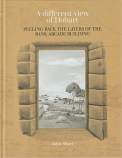
Peeling back the layers of the Bank Arcade Building.
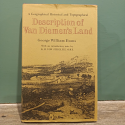
Facsimile of George William Evans's 1822 description of Van Diemen's Land, written for prospective emigrants, with a fold-out map and an introductory note by K.R. von Stieglitz. Hardcover with dustjacket, 1967, 140 pages.
![A History of Goldmining on the Tasmanian West Coast - Corinna, Mt Heemskirk & the Pieman River gold rush | Hans Julen | 1981 [USED – SC – Out of Print]](https://onlinestore.bookcellar.com.au/images/T/history-of-goldmining-westcoast-lw04U6.png "A History of Goldmining on the Tasmanian West Coast - Corinna, Mt Heemskirk & the Pieman River gold rush | Hans Julen | 1981 [USED – SC – Out of Print]")
Gold was discovered in the tributaries of the Pieman River from the late 1870s, and the boomtown of Corinna sprang up at a key river crossing point, becoming a jumping-off point for prospectors pushing on to Mount Heemskirk, Zeehan and Mount Lyell.
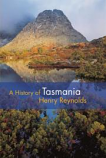
Henry Reynolds' history of Tasmania charts the history of Tasmania from the arrival of European maritime expeditions in the late 18th century, through to the modern day.
![A History of Tasmania – Complete 2-Volume Set | Lloyd Robson | 1983/1991 [USED – HCDJ – Out of Print]](https://onlinestore.bookcellar.com.au/images/T/history-of-tasmania-2volume-set-robson-nl3dGd.png "A History of Tasmania – Complete 2-Volume Set | Lloyd Robson | 1983/1991 [USED – HCDJ – Out of Print]")
The complete two-volume academic history of Tasmania by Lloyd Robson, widely regarded as the standard modern historical treatment of the island's past. Together the two volumes constitute the most thorough and rigorously researched single-author history of Tasmania available.
![A History of Tasmania – Volume II Only: Colony and State 1856 to the 1980s | Lloyd Robson | 1991 [USED – HCDJ]](https://onlinestore.bookcellar.com.au/images/T/a-history-of-tasmania-volume-2-only-robson-lloyd-g7TCSv.png "A History of Tasmania – Volume II Only: Colony and State 1856 to the 1980s | Lloyd Robson | 1991 [USED – HCDJ]")
Volume II of Lloyd Robson's two-volume A History of Tasmania, sold here as a standalone book. This volume covers the period from 1856 — when Tasmania achieved self-government and the colony's name was formally changed from Van Diemen's Land — through to the 1980s.
- per page